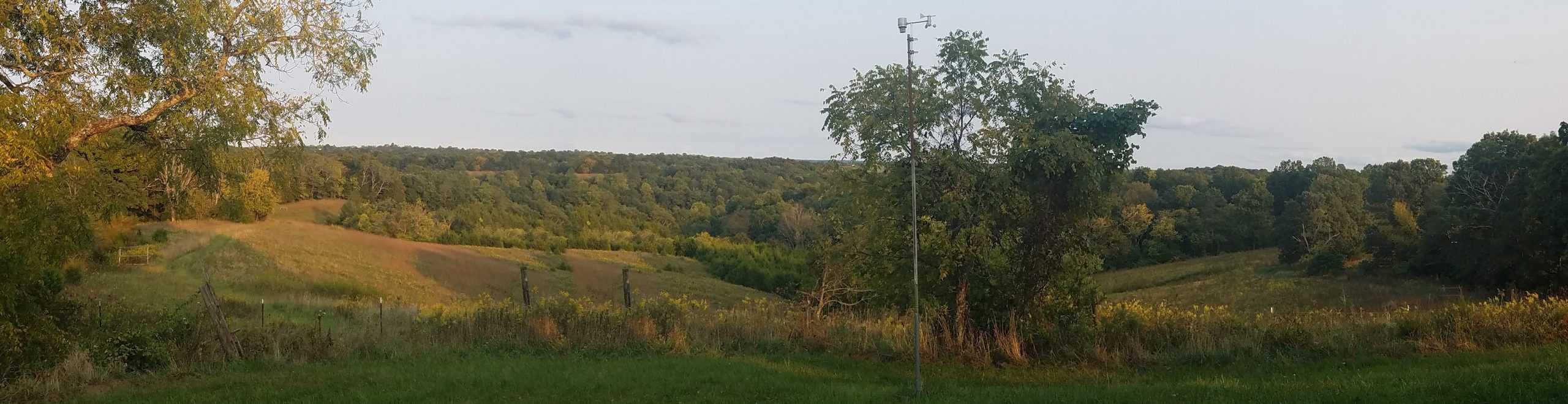
Food Plots 2026
Moose, Mooselette, and I have been working on food plots these past few weekends. It all culminated in two days of seeding and harrowing over the past couple of days. I would like to summarize our work for you.
The Setup
We’ve got 200 acres in SW Bracken County, KY. About 40 acres are pasture. I started last year converting 8 acres into foodplots. Since most Buck-on-Bag seed bags are meant to cover a quarter acre, I subdivided the larger plots into 1/4 acre sub-plots. Last year’s attempt was hampered considerably by drought. The clover in 6 of 8 plots failed to show. The summary of last year’s work is here:
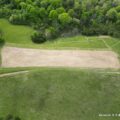
Luckily, Google Earth took a snapshot of the place in the midst of planting:
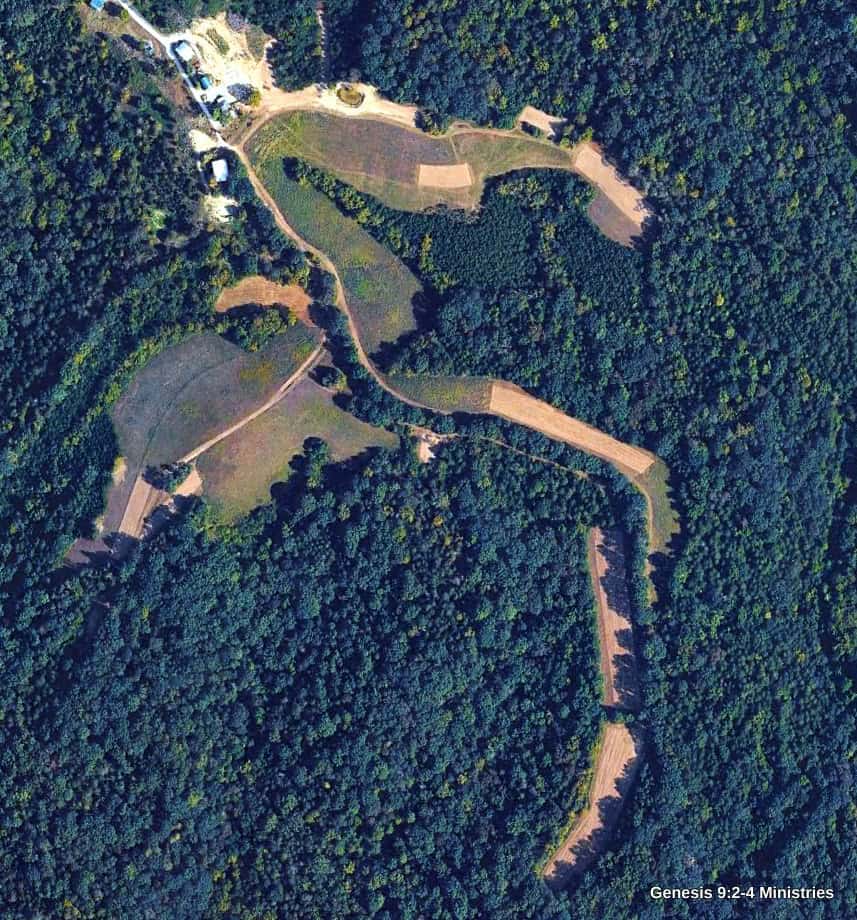
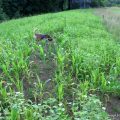
Coming into 2026, I made a bunch of adjustments. First off, the Google Earth image allowed me to accurately measure the plots. Some plots that had been estimated too high–two bags instead of three, etc. In a few rare circumstances, the clover survived and grew extremely well. One of these, Broken Corners, had been completely moribund in the spring, but when I went to till it in August, a lush carpet of White Dutch Clover was there.
I chose seed both this year and last based on a desire to experiment. I used the fancy Buck-on-Bag mixes, just because it gave me the most variety. Once I work out what works, I’ll try to source it locally. For now, it was just easier to browse the seed companies and order off Amazon or Sportsman’s Guide. This year, I added a third source: Hancock Seed Company. They came highly recommended.
What Seed?
From Hancock Seed:
From Whitetail Institute
- Chic Magnet
- Secret Spot
- Winter Peas Plus
- Extreme
- No-Plow
- Full Strut for Turkey
- Grunt N Gobble
- Oats Plus Triticale
From Evolved Harvest:
- 7 Card Stud
- Shotplot
I also purchased various bulk clovers from Amazon, including Ladino, White Dutch, Red, and Crimson varieties.
What drove these choices? Mostly price. I caught some wicked sale prices on Amazon and Sportsman’s Guide. In the latter case, a sale combined with a promotion, the membership discount, and free shipping–couldn’t beat the deal. With Amazon, it was just a matter of trolling through, starting in spring.
Another big issue was soil. I was hoping for the brassicas with their big taproots to dig down and start bringing up nutrients. Most of those radishes, beets, etc. never showed– killed off by the drought. I doubled down this year, because I knew the rain situation was going to be better. I also added chicory into a lot of the mixes. That is another plant known for bringing up nutrients from deep down.
My overall goal is to come away from this year’s planting with maybe half of the plots getting perennials surviving. Long term, I want to start rotating all my plots with perennials rotated every three years, with a year of brassica and grains.
The Process
Starting in mid-August, I started mowing down every plot with the brush hog. In the middle of Hollywood, the tractor sputtered and died. It took Moose a good long while to suss out the problem; the fuel had acquired a biofilm that had clogged the fuel filter. He had it running again by mid-week, and by the next Sunday, everything was mowed.
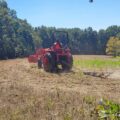
Last weekend was all about fertilizing and tilling. I dumped 21 40lb bags of 12-12-12, 1 per 1/4 acre with the spreader on the ATV, and then turned things over to Moose, the tractor, and the rotary tiller.
Moose found it going quite a bit easier than last year’s slog. In all places, the ground had not been turned over in at least 25 years. In some places, it had been a couple of generations. This time through, the soil was considerably more friable, and noticeably grayer from all the organics.
But Shaman. . .
Let me stop to answer a few questions:
Why Buck-On-Bag?
I know, it looks expensive and lazy, and it partially is, but I’m still trying to figure out what works. By next year, I should be able to start sourcing bulk seed from local suppliers.
Why Oats over Rye or Wheat?
Last year, it was just expediency. I went to buy seed at the feed store, and all they had was oats. Oats are cheap. Oats are top of the list for deer. The only problem with them is they die out in winter in the Northern climates. I had nothing else to plant, but I found that the oats survived– worst winter in over a decade. Fine. Oats it is. Some of the mixes had wheat, rye, and triticale as well. Fine. It all works.
Big Surprise: Annual Rye
Something that I figured out last year was that every time you see something like “Throw and Grow” on the bag, the bulk of the seed is going to be Annual Ryegrass. Most guys try to avoid it like the plague. They say it is only marginally palatable to deer, and it’s a bear to get rid of in successive years.
I ended up with a few bags of it last year. Mostly, I was bamboozled by the price. It’s cheap. I tried it in a couple of plots. In one spot, I had nothing left but subsoil from the bulldozer grading for the new house. In another, it was a quarter-acre of Broom Sedge that was mostly bare dirt. In both cases, the deer were attracted to these plots and were visiting them all winter and into spring. Both plots died off. I put one mix, Whitetail Institute No-Plow back into a couple of plots to see if it will work again.
I’m not saying Annual Rye is fantastic. I’m just not as down on it as a lot of other food plotters. We’ll see. In my case, it seems to be able to attract deer while acting as an anchor for clover, etc.
Why Roto-till? Why not No-Till?
Glad you asked. There are a bunch of factors that influenced my decision to broadcast seed over rotary-tilled ground. First is cost. YouTube is filled with guys doing their plots with no-till drills, and doing all their work with just an ATV or UTV. I decided that there was enough other work on the farm to justify a tractor. Given that, adding a rotary tiller was not such a big deal, and any sort of seed drill that could do the job was 2-3 times the cost. Additionally, my end of the county is extremely rocky, and the ground I’m working has not been worked in a generation or two. I was going to have to plow it or till it no matter what. When you see the YouTube videos of guys pulling a $12K no-till contraption over their land, you’re not seeing all the fuss that goes into it. Notice in those no-till videos how everyone is talking up the customer service and warranty associated with that equipment. Even on good ground, this stuff breaks, and I don’t want to be stuck with a $12K contraption waiting on parts to be overnighted. There is not a whole lot of AG in this part of the county, and what does get done is mostly done with tilling and disking.
Then there is Throw-n-Mow. Last year was a struggle with the tiller. This year, things were considerably easier. The ground had already been tilled once. We got the job done in a fraction of the time. Now that the ground has been tilled and fertilized twice, next year I can start experimenting with seeding into stubble and then mowing over it.
What about herbicides?
I had already purchased the glyphosate and an ATV sprayer to kill all the weeds before planting. I held off last year and the gly is still sitting in the shed. The first reason is that I tested the sprayer with just water. The ATV is fine. The sprayer is fine. The problem is that when you put the two together and fill the tank, it all becomes an unwieldy mess. Time was growing short last year, and we opted to skip the spraying. The results? Yeah, we had weeds, but we still had plenty for the deer and turkey to chew on. Then there was the thought of spraying poison on stuff that is intended to be eaten by the things you want to eat. I’ve already had cancer, and the chemo damn near did me in. The more we thought about it. . . the gly is still in the shed. I’m open to offers.
Back to The Process
So first, we mowed, then tilled. We tilled as deep as we could. We found that setting the tiller any higher caused it to bog down. That sounds counter-intuitive, but Moose decided the extra bite allowed the roots and stems to get chewed up better. After that, I fertilized with 12-12-12 at a rate of 160 lbs per acre. Did we do a soil test? No. I did one years ago, and I knew it wasn’t all that deficient. I wanted to see what a year’s work did before I tested it again. The one thing I knew about the soil was that it was deficient in Phosphorus. I could tell, because the whole property was covered in Broom Sedge. Surprisingly, that little bit of fertilizer last year was enough to keep Broom Sedge out of all the plots. I know I’m on the right track.
We all got down on Friday afternoon. Yikes. It was the hottest day of 2026, 97F. It broke the record. I spent all afternoon huddled next to an air conditioner that was losing ground by the hour. By the time the sun set, the temp in that room was 85F, and it barely cooled down overnight.
On Saturday, I got going early with Mooselette, portioning out seed. The Hancock Fall & Winter was a single 40lb bag meant for 1 acre. That got portioned out into 4 bags. Some bags were half-acre and got broken into two. By the time Moose came in from hunting, we had enough that he could start seeding.
The hardest part was the clover mixes. I had 1.5 acres of clover mix that had to be inoculated; then got the Chicory mix was added in and then folded into 5 portions of the oat/triticale mix. I used the grain to add bulk to the seed so it would go through the seeder.
We had to break for a thunderstorm mid-morning. This sucker blew up from nothing over 15 minutes and hit the farm like a gut-punch. Moose was caught off guard and came in from hunting on the ATV, completely drenched. It was a goodly downpour, but the fields were still firm. Moose had 7 plots planted before we broke for lunch. It was getting hot. There was rain expected in the afternoon. We had a good start and decided to hold off until Sunday to finish off.
Wow! It got to late afternoon, and a storm built over the Ohio River and moved south over us. A huge cell dumped on nearby Brooksville– lots of limbs down and power outages. We watched it from the porch. Our turn came about an hour later as the tail of that storm blossomed. We had wind and rain for about an hour, but we stayed dry out on the new porch. That was, until the wind shifted, and then we were running inside.
Larger plots got broken up into 1/4 acre chunks. I’m getting down in the weeds in this part, but it’s my weblog, and I need to get this recorded somewhere. I used a rangefinder and shot the length of each field that needed subdividing:
- Midway North: 188 yards– 37.6 yards per plot
- Midway South: 190 yards — 38 yards per plot
- Hollywood: 168 yards — 41.9 yards per plot
Width did not matter at this point; I’d figured out the acreage from measuring on Google Earth. 1.25 acres got divvied up 5 ways. 1 acre became 4 plots.
We then went down the field, depositing bags at the top corner of each plot. I shot the distance between each bag, working off my master worksheet. By the time we got back to the house, we had 14 bags out. Moose then came out with the ATV and spread each bag. When he was done with a field, we went over it with our harrow.
Three fields, 14 plots, about 2 hours to get it all done. Moose started feeling the heat about 2/3 of the way through and turned it over to Mooselette, who finished things off. I was back in my recliner in town before 1500.
Here is what got planted where:
- Midway North plot 1: Imperial Whitetail Grunt N Gobble
- Midway North plot 2: Hancock Seed Fall and Winter Mix
- Midway North plot 3: Evolved 7 Card Stud
- Midway North plot 4: Evolved ShotPlot
- Midway North plot 5: Imperial Whitetail Chic Magnet doped with Oats/Triticale and Clover Mix
- Midway South plot 1: Imperial Whitetail Grunt N Gobble
- Midway South plot 2: Hancock Seed Fall and Winter Mix
- Midway South plot 3: Evolved 7 Card Stud
- Midway South plot 4: Evolved ShotPlot
- Midway North plot 5: Imperial Whitetail Secret Spot with Oats/Triticale and Clover Mix
- Hollywood plot 1: Imperial Whitetail No-Plow
- Midway Hollywood plot 2: Hancock Seed Fall and Winter Mix
- Midway Hollywood plot 3: Evolved 7 Card Stud
- Hollywood plot 4: Imperial Whitetail Chic Magnet doped with Oats/Triticale and Clover Mix
- Faulty Towers 1: Imperial Whitetail No-Plow
- Faulty Towers 2: Imperial Whitetail Winter Peas Plus
- BlackBerry 1: Imperial Whitetail Full Strut
- BlackBerry 2: Evolved 7 Card Stud
- Fountain Square 1: Hancock Seed Fall and Winter Mix
- Fountain Square 2: Evolved 7 Card Stud
- Jagende Hutte 1: Hancock Seed Fall and Winter Mix
- Jagende Hutte 2: Imperial Whitetail Extreme
Some of these mixes promise germination in 4-7 days. With the soaking they got on Saturday, I think some of these plots might match that boast. Now, all I need is a reasonable amount of rain between now and the first frost, somewhere around Halloween.
This post has already been read 1675 times!
Views: 37

Thanks. That’s a detailed report. If the rain cooperates you should have a good crop of feed. Be Well Brother.