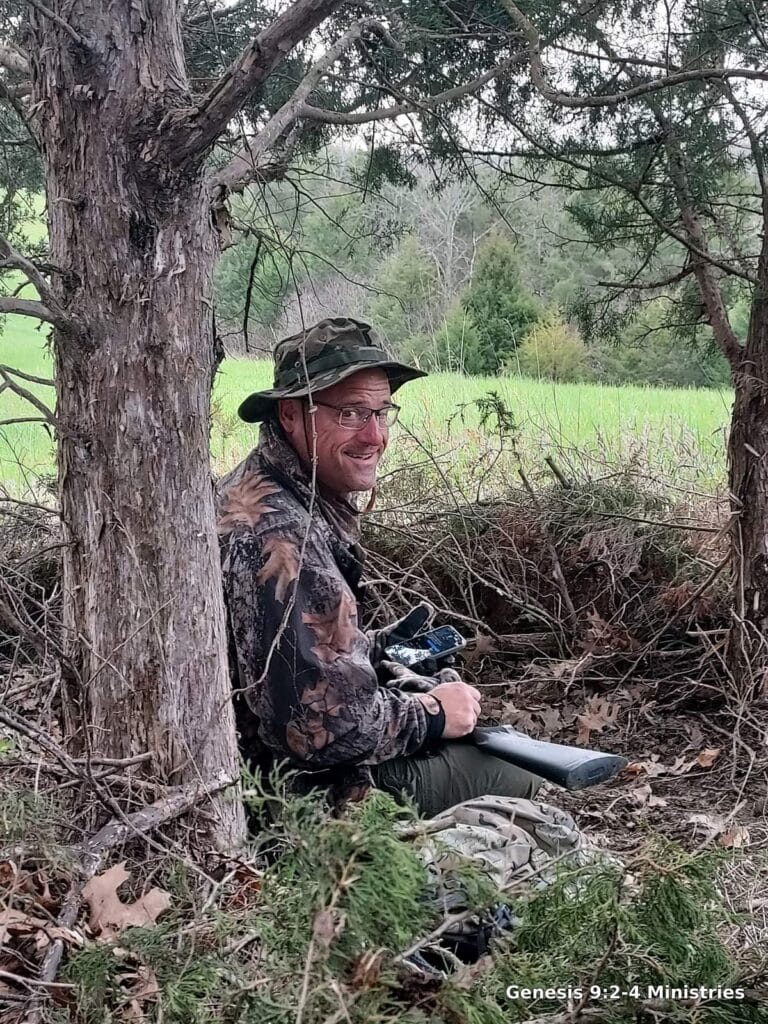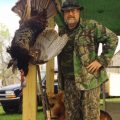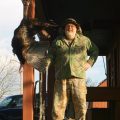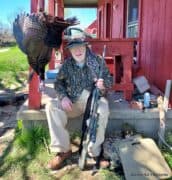
I am now cleaning all the guns and putting all the clothes in a big pile to do up for fall. Season is over.
This was my first really good season in several years. Last season was miserable, even though I got a bird on The Opener– something I had never accomplished before. The big problem was my health– a bad cold that would not quit and finally settled in my lungs. The other big problem was weather, and that probably did a lot to bring on the former. This year, the weather was probably the most to blame for this year’s success a much as last year’s misery. The mild winter meant a lot of turkeys got a break. The warm spring meant the gobblers were all hot to trot early. Of course, saying this, I can remember bad winters and nasty springs that brought on phenomenal action as well. My view is that a warm spring brings out the best in gobblers. Even if Opening Week turns bitter cold, it is still that early end to winter that seems to turn the trick and make for a banner year.
Pre-Season Scouting
Pre-season scouting also helped. I have only 200 acres to hunt. That sounds like a lot to someone that has less, but in terms of turkey, it is only enough in my case to hold a few flocks. The disposition of the flocks ended up being a key to the whole thing. For a change, I did not have any flocks particularly active in either the far west or far east of the farm. That ruled out a bunch of hunting venues that I would have normally been working. Scouting in the pre-season is a controversial topic. A lot of guys will tell you it does nothing but hurt your chances at getting a turkey. They can take a hike. I get out as soon as I get back to camp, and I keep going out up to the opener. I follow some basic rules:
1) I do not call. It is illegal in Kentucky to call from March 1 to the start of season. That is a good idea. I go beyond the law. No locators (legal in KY), no hen calls, no nothing. I just try to be part of the foliage
2) I stay well back from roosts. I listen from a distance.
3) I camo up like it’s season.
I try to fade into the background and be as unobtrusive as possible. The whole idea is to see and hear but not be seen. This year the scouting paid off. With both gobblers I shot Opening Week, I had roosted them and been able to follow them after flydown on at least one occasion prior to season. I knew their general habits. A third gobbler I had patterned did not make it past Opening Weekend. He must have strayed off the property and gotten in trouble.
The other thing pre-season scouting does is get the bugs worked out. If your flashlight eats batteries, you will find out. If you cannot see out of your new face mask, you will know. I found out my thermos leaked this year. When the Opener came I had already had my full kit out several times, save calls and shotgun.
Since there was no action except at the middle of the property, I ended up using my better venues a lot more this year with little rest. The Honey Hole got a lot of work this year. Surprisingly, the turkeys did not seem to mind. They took quite a bit of calling and quite a bit of other intrusions and kept on coming. Of course we were doing our best to be careful. I am not saying my turkeys get the same treatment that public land turkeys get. However, I was surprised how resilient they were.
Huntable Birds
More than ever, I am convinced there are just so many days a year when the gobblers on my place are going to be huntable. I spent a lot of time in the field. I listened to a lot of gobblers. I do not mean this as an excuse, but rather an explanation. Given a set bunch of turkeys, there just seems to be only handful of days each season that the gobblers are able to be hunted with the normal combination of calling and woodsmanship. Here are the factors that come into play:
1) Some of this is due to the breeding behavior of the turkeys. The gobblers get cranked up due to air temperature. Relatively warm or hot weather seems to make them more excited. Hens are supposedly controlled more by the length of day. The result is that the hens’ behavior is going to be pretty well set, with very little variability. The gobblers blow hot or cold– quite literally.
2) Weather. Rain seems to dampen the breeding behavior of my gobblers. I do not mean to suggest that rain in the forecast should be reason to stay home. I mean that overall bad weather– rain, fog, wind, etc. seems to dampen their spirits and make them less active and less vocal.
3) Hunting pressure. I’m sorry. I’m just not seeing it. For some reason, my birds were concentrated more to the center of my property this year. I hit the same places every day. 90% of my hunting activity for the whole season was in less than 5 acres of my 200 acre farm. Yes, I do believe my turkeys were a bit wary, but even the pair of jakes I shot at during Opening Week came to calls from the same blind 2 weeks later. I think that prolonged hunting pressure will affect turkeys, but they seem to have a very short memory.
I really wish I could give you a formula for what makes the gobblers hot. After 30 years, I still do not have an overall pattern discerned. I cannot say, for instance, that a temperature below 42F and winds in excess of 15 mph will make the gobs go into hiding. The fact is that I have now taken gobblers from the same blind in 25 degree weather and bone chilling wind as well as hot and muggy weather with a thunderstorm on the horizon. Rain, sun, early season, late season, there always a fair chance the gobs not cooperating.
Bottom Line? I have equally bad chances of having a gobbler present himself any day or time in season. If I was really being sensible about this, I would stay home. However, nothing about turkey hunting is really sensible.
This was also an odd year in that, although I shy away from calling birds in at flydown, I managed to call in a bird from his roost a good 200-300 yards away. Go figure. I am still scratching my head on that one. What I think closed the deal on this fellow was that I showed a willingness to meet him a little closer to half-way. When I heard he was interested, I closed the distance a good hundred yards. That was what did the trick. It was an important lesson, and one that I will use a lot in years to come.
Calls and Calling
My choice in calls was quite a bit different this year. I started out with my old goto call, a Quaker Boy Grand Old Master box call that never produced a single response. That call was quickly taken out of the rotation and I ended up ditching all the box calls this year. I used my Heirloom Double Barrel– mostly the slate side this year. I also used (don’t laugh) my Quaker Boy push-pin calls (I have a double and a single). I usually keep one or the other in my kit, because I find they’re the easiest to do purr-and-cluck feeding calls. The money call this year was definitely my new shamanic slate over glass with a purple heart striker. I do not mean to brag, because this is just a simple pot call built from parts supplied by CustomSawing.com. I’d love to know what I am doing right, but this thing kicked some serious butt on the gobs this spring.
An honorable mention also has to go to a package of 4 mouth calls I picked up on closeout from the Knight and Hale website. I lost the card and I have no idea what calls they were, except that one was a fairly laid-back double reed and the rest were various off-the-wall multi-reed affairs with exotic cut-outs. I usually go trolling through the various websites looking for deals in January, and when I can find 4 calls for under $15, I snag it.
Podcasts:
I hope you all liked the podcasts. I plan on doing more of them, now that I have all the bugs worked out. They are fun to do. I just wish y’all would let me know what you think about them. It would be easier to tailor them more to y’alls’ liking if I knew what was working for you.
Guns and Ammo
I am still a big fan of 3″ #4 Federals. I am not an Old Schooler by nature. Whatever works, I’m cool with it. The thing of it is that while the rest of the world has been spiraling into ever more exotic (and expensive) loads, I have been sticking with what I picked in 1996. The new Carlson’s Dead Coyote choke tube works well with the Flight Control Wad– a lot of these wad-stripping tubes won’t. The key thing here is that I find that I hardly ever get a chance to nail a gob out past 20 yards. This year it was all the more so, because the warm weather caused a lot more ground cover to be out.
This was going to be our last chance. Angus and Supercore both had gone dry going into the last day of season. Saturday had been plagued with rain that had kept the gobs quiet and the hens hiding. Angus did manage to nail a coyote around sunrise that came to our calls. We could not recover the carcass.
This was it– last day of season. SuperCore went out to Broken Corners. I took Angus to Quarterway– halfway between the Honey Hole and Midway. We heard nothing except a gobbler off the property getting cranked up, but there were a bunch of shots approaching 0800.
I was on the other side of the tree from Angus, and did not see anything until he fired. You can hear a couple of clucks as two jakes came within a few feet of the blind and then started to spook as Angus brought his gun up. One ran off toward the Honey Hole. The other ran right into Angus’ sights and a round of #4 Remington Nitro Magnum.
Good work, son!
SuperCore saw and heard nothing. After we got the jake skinned, I called SuperCore in and we went back out to hunt the Garbage Pit Burglar. He called a few times while we were on the porch, but after an hour, we could not get him to come closer to our blind at Fountain Square. Drat. It’s a Butterball season for SuperCore, but he’s had a great time.
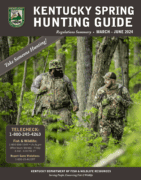
Most hunters know how white-tailed deer change their habits during the fall rut cycle. Surprisingly few hunters, however, consider the transitions of wild turkey behavior during the birds’ own “rut” in the spring.
Turkeys undergo five transition phases in the spring. Although birds may not go through all these transitions during a typical hunting season, Kentucky gobbler enthusiasts can increase their odds of success by learning to identify these phases and tailoring their hunting tactics accordingly.
I found a lot of good knowledge in this article, back in 2003, and I try to re-read it every year, going into season. This year, I could not find the old ratty magazine, so I though I would look for it online.
Things developed slowly today, but the gobbler I podcasted the other weekend back at Virginia came in through the back door, cakewalking down the road like he owned the place. He got to the gate leading to the Honey Hole and met up with some #4 Federal from my Mossberg.
That’s it for me, but Angus and SuperCore still have plenty of tags. SuperCore was out with me this afternoon. We were pinned down by five hens out at Midway, but no gobbler showed.
I just got in from hunting with SuperCore. We went back to the Honey Hole and got blanked– nothing. The winds are gusting to 20MPH and are expected to hit 40 MPH before the end of the afternoon. This is one of those rare occasions that the wind is going to keep me in. I was out in the woods during Hurricane Ike, and I don’t want to go through that again– too much danger of falling limbs. The National Weather Service has put out warnings for folks traveling on East/West roads to be careful. Then they start putting out small car warnings, I know to take heed.
I talked with O.T. today. He’s had miserable luck so far and has seen only one turkey since season started.
I went out this morning with low expectations. Rain was due before Noon. I figured that there would be nothing particularly hot, but the opener is after all The Opener, right?
Angus and SuperCore went out to Broken Corners. We are fairly convinced that gob that I caught on the Podcast a couple of weeks ago is indeed Mister Moto. That makes the third season he’s been gracing the Hundred Acre Wood. Angus and SuperCore went out to kill him.
I went to the new blind Angus and I prepared halfway between Midway and the Honey Hole. Halfway to Midway. What does that make it? Quarterway? I sat through sun-up and there was little going on. However, one gobbler that I scouted out earlier in the year had kept his roost at the head of Hootin’ Holler. He kind-of sort-of honored my calling, so I decided to cut the distance to him and went back to the Honey Hole. That is when he got interested and hopped down off his limb and made a beeline for me.
The stats on this guy? He was a big healthy 2-year old:
Weight: 22.5 lbs
Spurs: Left= 5/8″ Right=3/4″
Beard: 10.5″
Mister Moto gave SuperCore and Angus the slip this morning. They stayed out until clouds piled up and it looked like it would open up at any moment. By the time they came in, I had the turkey in the freezer and was pulling the mower out to get an acre or so done before the rain arrived– missed getting it all done by less than five minutes.
It has been raining ever since.
Team #2: I’m on the board.
Em and Scott: So who won the bet?
It’s the day before the Ky Yute Opener. Angus and I did some last minute scouting this morning and found a gobbler less than 60 yards from us at Broken Corners.
NOTE: I broke the previous podcast into two parts after some folks said it was too slow to load. I’ll try and keep these to about 15 minutes per segment in the future.
I was out last weekend pestering the turkeys and I came upon a herd of 5 deer camped out under one of my stands, worrying my salt lick. It reminded me that now– I MEAN NOW!!! — is the time to start making or rejuvenating salt licks. There was enough salt in mine, leftover from last year, to hold their interest. However, you need to have your licks established early. By Summer, they’re not going to be nearly as useful.
Contrary to popular belief, new salt licks are well-near useless during hunting season. You cannot just put out salt the week before The Opener, and expect deer to come flocking. Licks are useful only because the tend to habituate deer to coming around the area of the lick. Deer are creatures of habit. They like to travel the same paths. You can mold those paths to run past your stand with a lick Deer have lost interest around mine by September. The hot time is May through mid-July. However, I see deer wandering by, not using the lick all year long. They start using them in March. So now would be a good time to get one started, or refreshed.
Here is a link to a good article by a wildlife biologist I know.
http://fw.ky.gov/mineral.asp
One other tip: Don’t expect a lick to work just anywhere. It helps to establish one close to where deer frequent. Find the beds, find the food, draw a line between the two and find the easiest way along that path. Situate your lick where it can help bend that path a little to bring them close to a treestand or blind. However, don’t expect it to work miracles. A lick will not manufacture deer out of thin air or take them to a place they would never go.
You also have to think about your neighbors’ licks and the number of licks in your area. You want your lick to work like a magnet. Too many licks in an area will dilute the effect.
I have 200 acres. I have 3 lick locations that work, and I have tried probably 10 more over the years that were hardly ever visited.
It’s April Fools Day, and the gobblers played a trick on me– had me running all over the farm. However, I finally got close to one out on the tip of Virginia.
NOTE: I broke this podcast into two parts after some folks said it was too slow to load. I’ll try and keep these to about 15 minutes per segment in the future.
Virginia is a “finger off a finger.” Our place is centered around a knife-edge ridge running N/S. There are a couple of smaller fingers branching off with small hollows between. Virginia is one of the larger ones.
I remember taking a walk like this back in 2002– first time I had really tried to hunt this part of the property. I spent all morning trying to coax a gobbler much like this one out of Soggy Bottom. It was on this day that I decided to leave Virginia alone and give it to #2 son, Mooseboy when he started to hunt on his own. There is a buddy treestand up about halfway out Virginia at its narrowest part.
How did Virginia get its name? Simple, there’s an old Ivor Biggun tune about a hillbilly. The refrain ends: “But halfway up Virginia is where I want to be!”
1And God blessed Noah and his sons, and said unto them, Be fruitful, and multiply, and replenish the earth.
2And the fear of you and the dread of you shall be upon every beast of the earth, and upon every fowl of the air, upon all that moveth upon the earth, and upon all the fishes of the sea; into your hand are they delivered.
3Every moving thing that liveth shall be meat for you; even as the green herb have I given you all things.
4But flesh with the life thereof, which is the blood thereof, shall ye not eat.