Turkey Season Post Mortem, 2025
It’s over.
The Shamanic Dream Team did not make it out for the last weekend. Moose had to stay home with Junior. Angus was dealing with a seasonal allergy. I was nursing a bad back. This all belies the real reason: nobody really wanted to be out in that much rain.
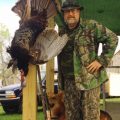
The Score? Three gobs. One was a bird of a lifetime, the other two were nice fat 2 year olds. I wish Angus had been able to score. The same goes for Foxtrot Charlie. However, in the latter case, he is a lot further down the path to success than I was at this stage of my career. He’s on his way.
I was trying to explain my thoughts to Foxtrot Charlie on why the action seemed to die in the latter half of the season. This year had me scratching my head– really no more or less than other years. It was just . . . different. That was what makes it all so confounding. Here I am 40-some years into my career as a turkey hunter. I should be able to see patterns. I don’t. Normally, I’m sort of half-expecting that the turkeys are slow to turn on in the first week of season. I expect things to heat up the first week. This year, they were hot on the Opener and then things slowly died.
Weather? I told Foxtrot Charlie that for every cold snap on an Opener that had shut gobbling down, I had seen another that had lit the birds on fire. For every warm-up like had occurred on the second weekend, an equal number had made the gobs go mad as had made them clam up and hide. I’d heard theories about barometric pressure and temperature and dewpoint, and nothing in all my log entries ever gelled into anything.
Roosting patterns? I’ve been on this farm for a quarter-century now. The turkeys regularly change roosts throughout the year and throughout the season. However, I cannot predict that a cold front will drive birds to roost lower on the hillsides or that a north wind will cause them to roost on south-facing slopes. It’s like they pull out a set of dice at 4 PM and roll for which tree is going to be home. Even this last bird of mine was proof of that. He’d been roosting in the same place on the north side of Gobbler’s Knob and come out to strut in front of Jagende Hutte. The hens had been roosting somewhere in Dead Skunk Hollow. I see him strutting in front of the blind at S10 one afternoon a half-hour after FC had given up and gone in. I set up the next morning overlooking the strut zone and realize the gob and hens both have roosted just behind me in Hundred Acre Wood, and I’m too close to the roost tree to move.
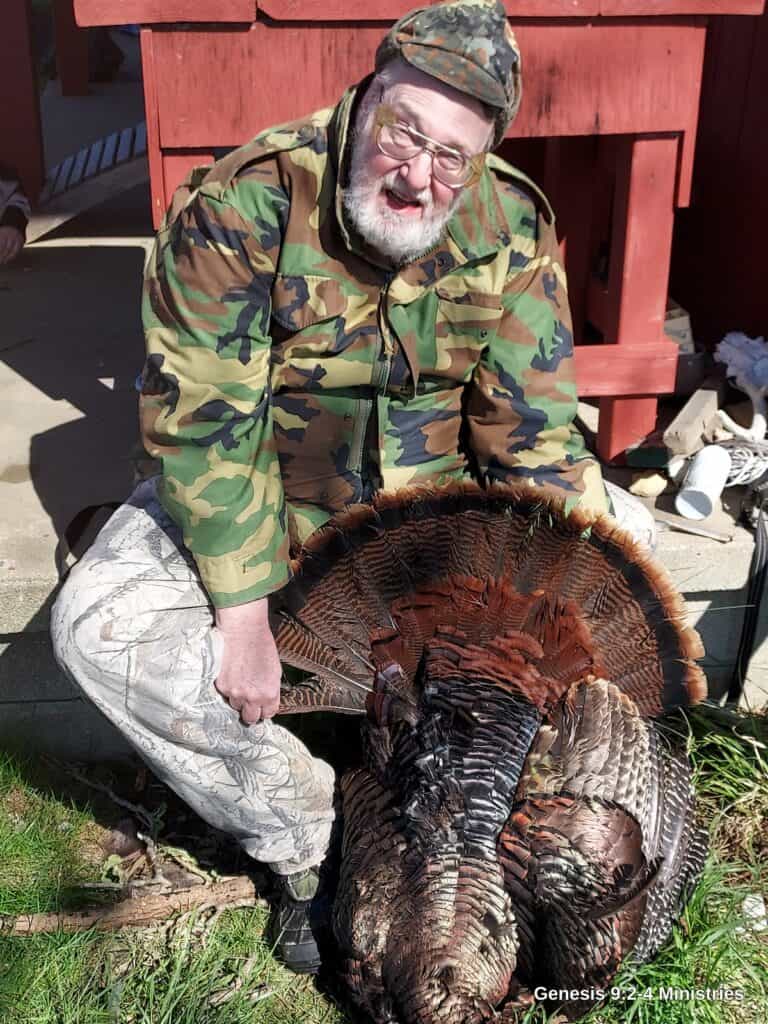
I think that sheer perversity of the birds is what finally tripped FC’s trigger. He’s now a committed turkey hunter. When I told him Eastern Wild Turkey was the hardest game on the North American Continent, I think he scoffed. He was booked for sheep hunt in British Columbia. He got his ram all right. Even with months of conditioning, he still barely made up the hill and back down. Still, all that prep and planning and exertion could not convince a bird with a pea brain to come close enough to shoot. This year, it was just satisfaction enough that he got a bird to honor his calls and start coming in before losing interest and turning away. Yep. Some years that really is the best you can hope for.
I’ve been watching the KDWFR Telecheck site. This year was by no means stellar. The current total harvest is 30,432. Last year, it was 33,465. Normally, I watch Bracken County and Pendleton County as I’m right on the line. Bracken was 262. Pendleton was 367. The overall trend for both counties is down, but Pendleton’s trend is more steeply negative than Bracken. The overall trend for the Northeast Region, which Bracken is in, is up (4259 birds this year.) However, Bracken’s share of the birds is going down. What this means is that the other counties in the Northeast are improving.
My forecast is that the return of the cicadas in a few weeks will be a watershed event for the turkeys. All that extra protein in the ecosystem should mean increased survival for the poults. In 2008, the last time this brood emerged, I had a ridiculous number of jakes and jennies running around that fall. The next year, we had the first appearance of the Gay Turkey Herd– up to 10 bachelor gobblers that spent all their time together, strutting for each other. It took years for that group to peter out finally. In the meantime, we had salad years where I was filling both tags every year.
This post has already been read 8081 times!
Views: 7

I predict that next year will find your perfect record of not being able to predict the birds, will remain unbroken. 🤭
Thanks for allowing me once again to come match wits with the birds.